

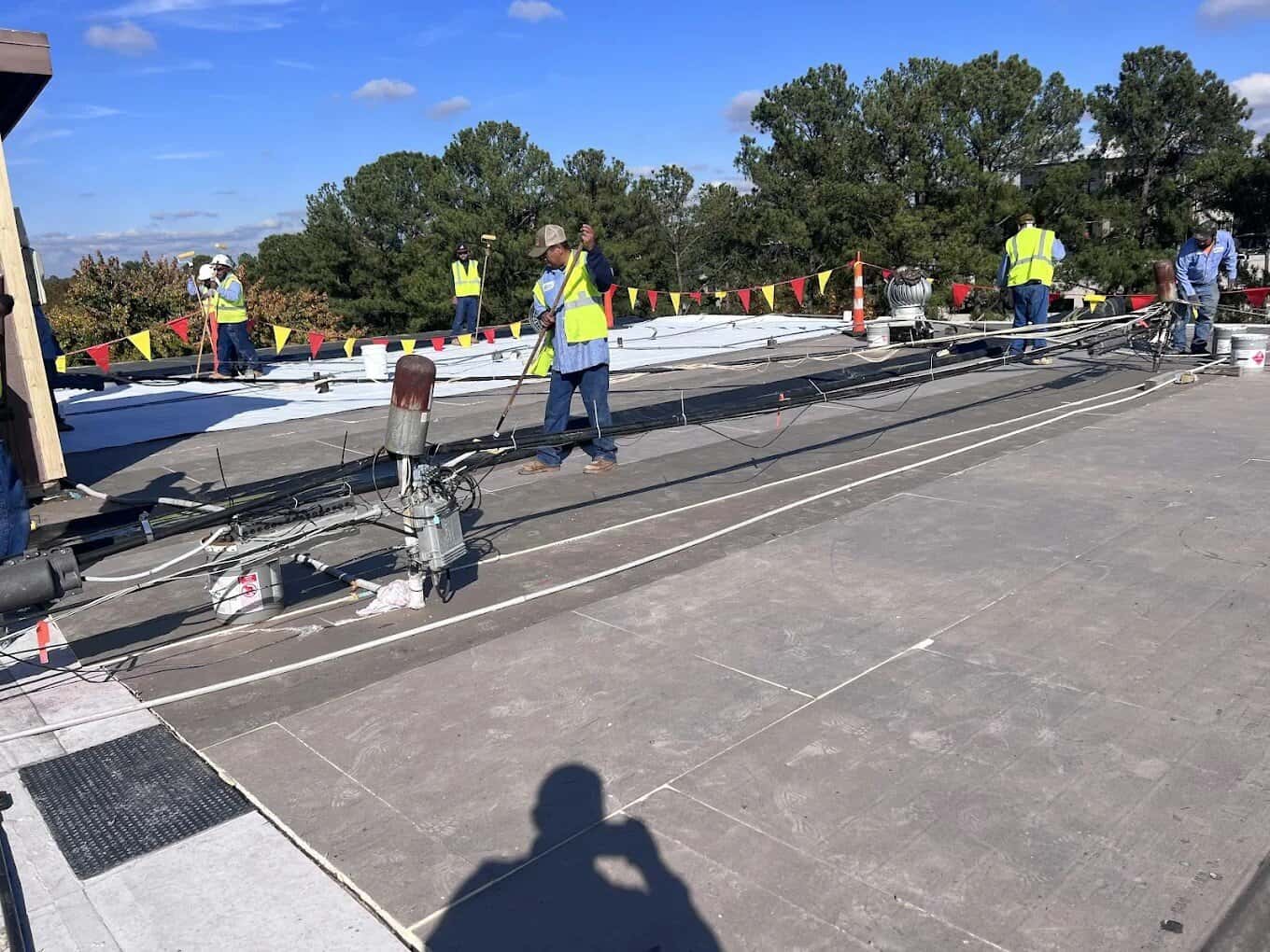
How To Repair a Flat Garage Roof
TL;DR — Key Points:
- Identify the problem first — leaks, blistering, cracking, and ponding water each require different repair approaches
- Safety before anything — inspect from a ladder before accessing the roof surface; never work on a wet or unstable surface
- Small repairs can be DIY — minor cracks and blisters are manageable with the right materials, but poor repairs often cause bigger problems
- Deck condition determines repairability — a rotten or structurally compromised deck requires full replacement, not patching
- Match materials to your existing system — felt, EPDM, TPO, and modified bitumen each require compatible repair products
- Repeated repairs signal replacement time — if a garage roof has been patched multiple times, a full re-roof is usually more cost-effective
- Professionals provide lasting results — The Flat Roof Specialists offer expert repair and full replacement across NC, SC, TN, GA, and VA
A leaking or damaged flat garage roof is one of the most common property maintenance issues homeowners and business owners face. Whether it’s a detached residential garage in Durham, a commercial garage facility in Greensboro, or a carport roof in Raleigh, flat garage roofs are exposed to the same weather, UV degradation, and age-related deterioration as any other flat roofing system — often with less attention paid to maintenance along the way.
At The Flat Roof Specialists, we’ve been repairing flat roofs of all types throughout North Carolina, South Carolina, Tennessee, Georgia, and Virginia for over 25 years. With more than 100 five-star reviews and certified expertise across every flat roofing material, we know exactly what it takes to repair a flat garage roof properly — and when repair is no longer the right answer. Give us a call at 919-834-7663 if you’d rather skip the DIY process and get the job done right the first time.
Step 1: Diagnose the Problem Before Touching Anything
The most common mistake homeowners make with flat garage roof repairs is jumping straight to patching the most visible symptom without identifying the actual source of the problem. Water is deceptive — it enters at one point and travels along the deck, dripping or staining the ceiling in a completely different location.
Start your diagnosis from inside the garage. Look for water stains, damp timber, mold patches, or daylight showing through any point of the ceiling or roof structure. Note where the staining is most concentrated and how far it extends, then map that against what’s above it on the roof surface.
Next, inspect the roof exterior from a ladder before stepping onto the surface. Look for the following common failure points:
- Blistering or bubbling — air or moisture trapped beneath the membrane, causing it to separate from the deck below
- Cracking or splitting — typically caused by UV degradation and thermal cycling in older felt or bitumen systems
- Lifted or open seams — where membrane sheets have separated at their joints, allowing direct water entry
- Failed flashing — at the junction between the roof surface and any wall, fascia, or upstand
- Ponding water — standing water that hasn’t drained within 48 hours of rainfall, indicating drainage or slope problems
- Soft spots — areas where the deck beneath the membrane has rotted or delaminated, creating a spongy feeling underfoot
Understanding exactly what you’re dealing with before starting any repair work saves time, money, and prevents making the problem worse.

Step 2: Assess Whether Repair or Replacement Is the Right Call
Not every flat garage roof problem warrants a full replacement — but not every problem can be fixed with a patch either. Several factors determine which route makes more sense.
Repair is appropriate when damage is localized to a small area, the rest of the membrane is in good condition, the roof deck is structurally sound, and the roofing system is relatively recent. A single blister, a small crack near a flashing, or a lifted seam at one location are all good candidates for targeted repair.
Replacement makes more sense when the membrane is more than 15–20 years old, when there are multiple problem areas spread across the roof, when the deck has significant rot or structural damage, or when the same repairs have been made repeatedly without lasting success. Our experience serving customers throughout Winston-Salem, Burlington, and High Point has taught us that a second or third patch on the same roof section is almost always a false economy — a full re-roof at that point costs less over time than ongoing emergency repairs.
If soft spots are present anywhere on the roof, the deck must be inspected before any surface repair begins. Patching a membrane over a rotten deck is pointless — the repair will fail quickly and the structural problem will continue to worsen underneath.
Step 3: Repairing Cracks and Small Splits
For felt or modified bitumen roofs with localized cracking, a targeted patch repair is often an effective solution when the surrounding membrane is otherwise sound. Here’s how to approach it correctly:
Clean the damaged area thoroughly, removing any loose material, dirt, or debris. Allow the surface to dry completely — applying any repair material to a damp surface is one of the most common causes of patch failure. For felt systems, use a wire brush to roughen the area around the crack to improve adhesion.
Cut a patch of compatible membrane material — the same type as the existing roof if possible — at least 6 inches larger than the damaged area in all directions. Apply bitumen adhesive or torch-bond the patch firmly into place, working from the center outward to eliminate any air pockets. Press and roll the edges firmly to create a watertight seal, then apply a lap sealant around the perimeter of the patch.
For EPDM rubber roofs, use EPDM-specific lap sealant and seam tape — never use standard bitumen products on rubber membranes, as they are chemically incompatible and the repair will fail. For TPO or PVC roofs, seam repairs require a heat welder and should be left to professional contractors.

Step 4: Repairing Blisters
Blisters in a flat roof membrane are caused by air or moisture trapped beneath the surface. Small blisters that are stable and not actively leaking can sometimes be left alone, but any blister that has cracked open or is growing must be repaired promptly.
To repair an open blister, carefully cut along the center of the blister with a utility knife, peeling back the edges to expose the area beneath. Allow any trapped moisture to dry out fully — this may take several days of dry weather. Once the substrate is completely dry, apply bitumen adhesive to both surfaces and press the membrane back down firmly. If the membrane edges are too damaged to lie flat, cut them back further and apply a fresh patch over the entire area as described above.
Never attempt to repair a blister in wet or humid conditions. Our teams in Chapel Hill and Fayetteville regularly encounter failed blister repairs where moisture was sealed in rather than dried out — the resulting rot and membrane failure cost far more to correct than the original repair would have.
Step 5: Repairing Failed Flashing
Flashing failures — at the junction between the roof membrane and walls, fascia boards, or chimney stacks — are responsible for the majority of flat garage roof leaks. The flashing on a flat garage roof is typically a strip of felt, metal, or specialist self-adhesive membrane that seals the transition between the horizontal roof surface and any vertical element.
To repair failed flashing, remove any loose or lifting material back to a point where it is still firmly bonded. Clean the area and allow it to dry, then apply new flashing material — ideally a self-adhesive modified bitumen flashing tape or torch-on felt strip — bonding it firmly to both the roof surface and the vertical face of the wall or fascia. The flashing should extend at least 6 inches up the vertical surface and be terminated with a metal cover flashing or appropriate sealant at its top edge.
Pay particular attention to corners, where flashing is most prone to lifting. Cut V-shaped notches in the flashing strip to allow it to fold neatly around inside and outside corners without bridging or buckling.

Step 6: Addressing Ponding Water and Drainage Issues
If your flat garage roof consistently holds standing water after rainfall, surface repairs alone won’t solve the underlying problem. Ponding water accelerates membrane deterioration, adds structural load, and dramatically increases the risk of leaks developing over time.
Minor drainage improvements can sometimes be achieved by clearing blocked outlets and gutters, or by applying a tapered overlay system that builds slope into the existing roof. More significant slope corrections require either overlay insulation boards cut to a taper or partial deck reconstruction — work that is best left to professional roofing contractors.
If you’re noticing consistent ponding on your garage roof in Raleigh, Durham, or anywhere throughout our five-state service area, call The Flat Roof Specialists for a professional assessment. Solving the drainage problem permanently is almost always more cost-effective than repeatedly repairing the membrane damage that ponding causes.

When to Call The Flat Roof Specialists
DIY garage roof repairs can be a reasonable approach for minor, well-defined issues on a roof that is otherwise in good condition. But when the damage is extensive, the deck is compromised, the roofing material requires specialist equipment, or the same area keeps leaking after repeated repairs, professional intervention is the right call.
At The Flat Roof Specialists, we are your certified and experienced commercial and residential roofing experts. We specialize in commercial flat roofing installation, repair, and maintenance, and also offer top-quality residential roofing services — especially if your home or garage has a flat roof. We proudly serve Raleigh, Durham, Chapel Hill, Burlington, Greensboro, High Point, Winston-Salem, and Fayetteville, and we install and maintain flat roofs throughout NC, SC, TN, GA, and VA.
Be sure to watch our YouTube videos, read our reviews, and check out our extensive gallery to see our recent flat roof repair work. Give us a call today at (919) 834-7663 to request a quote — we’ll assess your garage roof honestly and recommend the most cost-effective path forward.