

How to Slope a Flat Roof for Drainage
TL;DR — Key Points:
- No flat roof should be truly flat — minimum 1/4″ per foot (1:48) slope is required by most building codes
- Four main methods exist — tapered insulation, sistered rafters, tapered crickets, and self-leveling overlays each suit different situations
- Drain placement drives slope design — where water exits determines how the slope must be engineered
- Tapered insulation is the most popular retrofit solution — installed above the deck without structural changes
- Structural solutions offer permanence — sistered or re-cut rafters correct slope at the framing level
- Ponding water is a serious warning sign — address drainage slope before it causes membrane failure or structural damage
- Professional design recommended — incorrect slope can redirect water toward walls or create new ponding areas
Proper drainage slope is one of the most critical — and most frequently overlooked — elements of flat roof performance. Despite being called “flat,” these roofs must have a measurable slope built into their design to direct rainwater toward drains, scuppers, or gutters. When that slope is absent, inadequate, or compromised over time, standing water accumulates on the roof surface, accelerating membrane deterioration and dramatically increasing the risk of leaks.
At The Flat Roof Specialists, we’ve been solving flat roof drainage problems throughout North Carolina, South Carolina, Tennessee, Georgia, and Virginia for over 25 years. From residential flat roofs in Raleigh and Durham to large commercial facilities in Greensboro and Winston-Salem, our team understands that getting the slope right is foundational to everything else a flat roof needs to do. With more than 100 five-star reviews, we’re the trusted experts for both new installations and drainage corrections. Call us at 919-834-7663 to request a professional assessment.
Why Slope Matters: The Problem with Ponding Water
Water that sits on a flat roof surface for more than 48 hours after rainfall is considered ponding water — and it’s one of the most damaging conditions a flat roof can experience. The consequences compound quickly. Standing water adds significant structural load, with water weighing approximately 5.2 pounds per square foot per inch of depth. Over a large commercial roof, even a modest pond can add tens of thousands of pounds of unintended load to the structure.
Beyond structural stress, ponding water accelerates UV degradation of the membrane, increases the freeze-thaw stress on seams and flashings, promotes algae and vegetation growth that can root into the membrane, and turns any minor imperfection in the roofing system into an active leak path. In North Carolina’s climate — with its heavy summer thunderstorms and occasional winter ice events — flat roofs in Burlington, Chapel Hill, and Fayetteville face these stresses year-round.
Most building codes, including those adopted across our service states, require a minimum slope of 1/4 inch per foot (written as 1:48) for low-slope roofing systems. Many roofing manufacturers require 1/2 inch per foot (1:24) to maintain warranty coverage. If your roof doesn’t meet these minimums, corrective action isn’t optional — it’s essential.
Step 1: Assess the Existing Slope and Drainage Layout
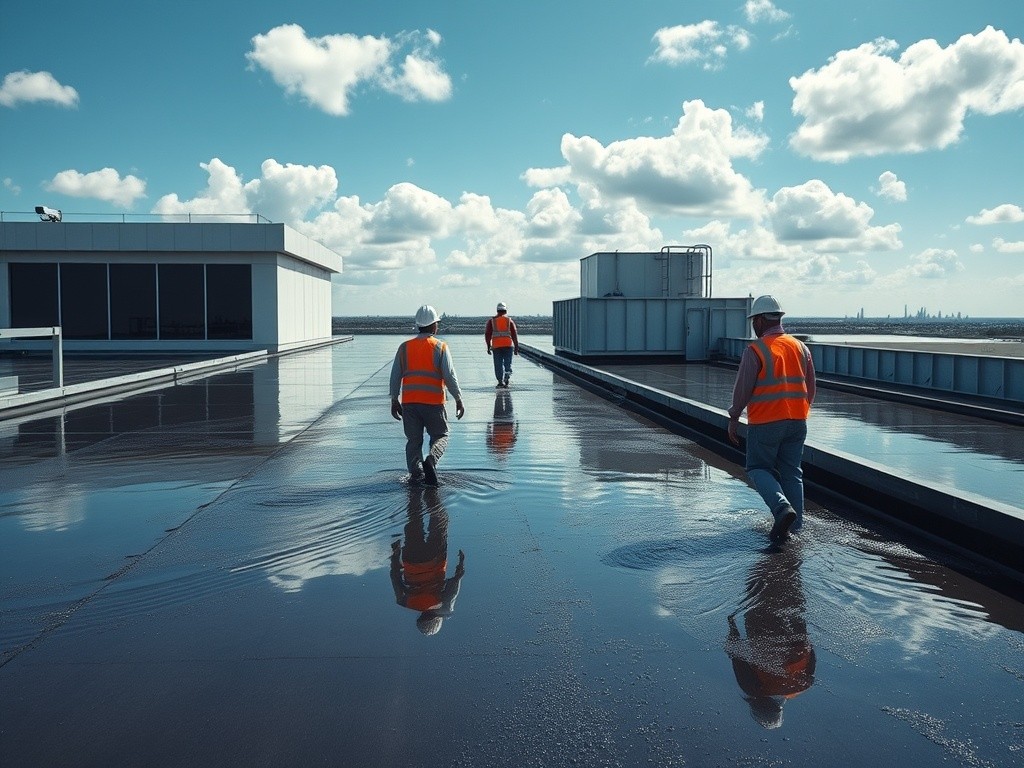
Before choosing a correction method, you need to understand the current state of your roof — where water is going, where it’s stopping, and how much slope correction is needed.
Start by mapping the roof after a significant rainfall, noting exactly where ponding occurs and how deep it gets. This tells you the low points that need the most correction. Then measure the existing slope using a 10-foot level and a tape measure — hold the level flat across the roof surface and measure the gap between the level’s end and the roof deck. Divide that gap by 10 to get slope in inches per foot.
Also identify where the roof currently drains — internal drains, edge scuppers, or gutters — and determine whether their placement is logical given the roof’s geometry. Drain placement should always be at the lowest point of the roof; if it isn’t, the drainage layout itself may need to be redesigned as part of the slope correction project.
Finally, assess the condition of the existing membrane and deck. If the deck has structural sagging contributing to the ponding, slope correction alone won’t fully solve the problem — structural repairs may be needed first.
Method 1: Tapered Insulation Systems
Tapered insulation is the most widely used method for adding or correcting slope on existing flat roofs, and it’s particularly popular for commercial retrofits because it doesn’t require structural changes to the building. The approach involves installing insulation boards that are cut or manufactured to gradually increase in thickness across the roof, creating a slope toward the drain locations.
Polyisocyanurate (polyiso) is the most common material for tapered insulation systems. Boards are available in standard taper configurations — typically starting at 1/2 inch thick at their thin edge and increasing at 1/8 inch per foot, 1/4 inch per foot, or 1/2 inch per foot increments. For complex roof geometries with multiple drains or hip-and-valley configurations, a tapered insulation layout must be carefully designed so that all water paths lead consistently downhill toward outlets.
The advantages of tapered insulation are significant: no structural work required, the insulation improves thermal performance at the same time it corrects slope, and the new membrane can be installed directly over the tapered system as part of a complete re-roofing project. The primary consideration is ceiling height inside the building — because the insulation is thicker at the high points, interior headroom is reduced accordingly.
Our commercial roofing teams install tapered insulation systems throughout High Point, Winston-Salem, and across our five-state service area as part of comprehensive flat roof replacement and drainage correction projects.
Method 2: Sistered or Re-Cut Rafters
For residential flat roofs and smaller structures where the roof framing is accessible, correcting slope at the structural level provides a permanent solution that doesn’t reduce interior headroom. Two approaches are used depending on the situation.
Sistering involves attaching new rafters alongside the existing ones, with the new rafters cut at a slope to create the desired pitch. The new rafters start at the same height as the existing ones at the high end of the roof and gradually taper upward toward the low end, raising the deck surface to the correct slope. New decking is then installed over the sistered rafters before the new membrane goes down.
Re-cutting existing rafters is sometimes feasible on smaller roofs where the existing framing has sufficient depth. This involves carefully cutting a taper into the top edge of each rafter to create slope, then renailing the decking to the new rafter profile. This approach is more complex and requires precise carpentry, but it avoids the cost of additional lumber.
Both structural approaches work best on new construction or complete roof replacements where all layers are being removed anyway. Attempting to re-slope by structural means on an occupied building with an intact roof is significantly more disruptive than tapered insulation.
Method 3: Tapered Crickets and Saddles
Crickets and saddles are small tapered structures — essentially mini-roofs — built on the main roof surface to redirect water around obstacles and toward drains. They’re particularly useful around HVAC equipment curbs, skylights, chimneys, and other roof penetrations that interrupt the natural flow of water across the roof surface.
Without a cricket behind a large HVAC curb, water dams up against the uphill face of the equipment, creating a persistent pond that degrades both the membrane and the equipment base. A properly designed cricket — typically triangular in plan and rising to a ridge at the center — splits water flow to either side of the obstruction and directs it cleanly toward the roof drains.
Crickets can be fabricated from tapered insulation board, framed from wood, or formed from sheet metal. They must be carefully integrated with the surrounding membrane and flashed at all edges. Our teams in Durham and Raleigh regularly install crickets as targeted drainage corrections on commercial roofs where full re-sloping isn’t practical or necessary.
Method 4: Self-Leveling Overlay Systems
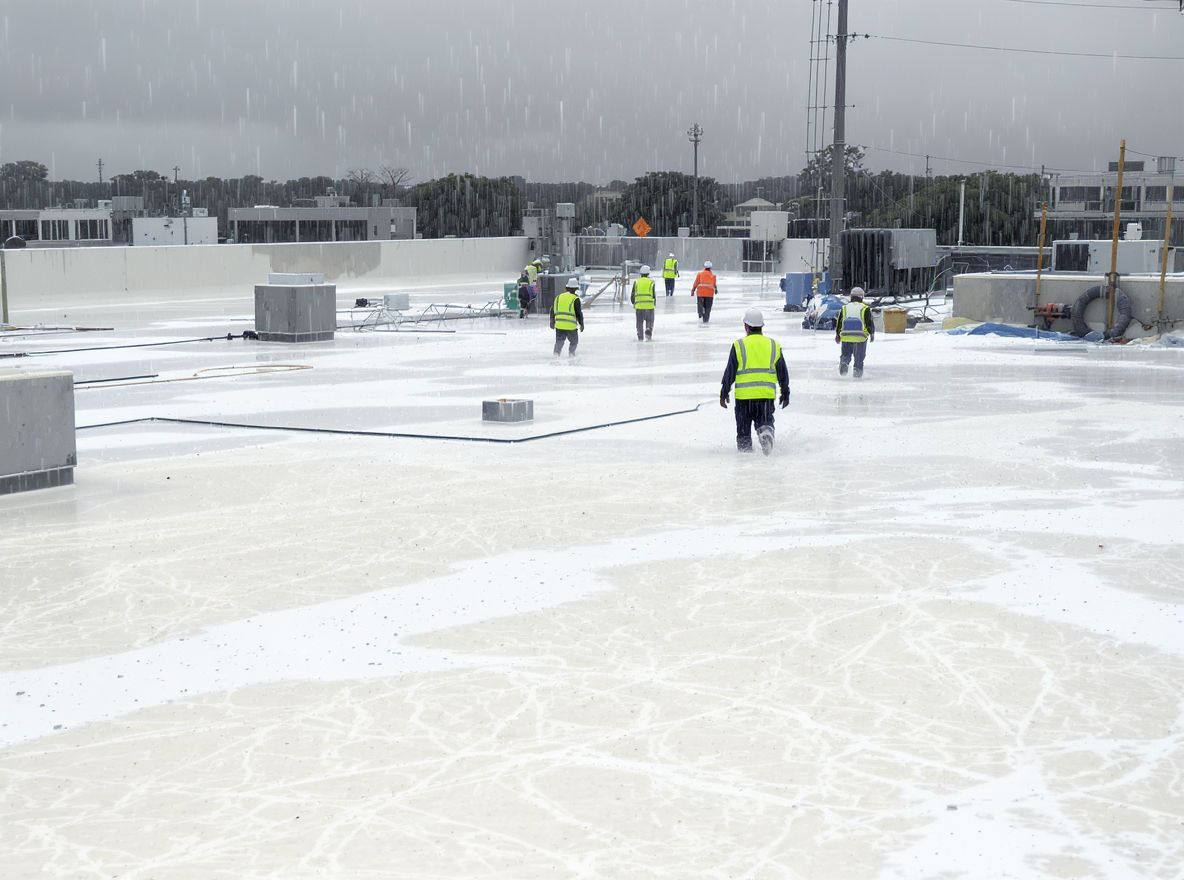
For some situations — particularly where ponding is minor and the existing membrane is otherwise sound — a pourable or trowelable overlay system can be used to build up low spots and redirect water flow. Lightweight cementitious or epoxy-based overlay products are applied to the roof surface, feathered out to create slope, and then topped with a compatible coating or new membrane layer.
This approach is lower-cost than a full structural correction or complete re-roof, but it has meaningful limitations. Overlays add weight to the roof structure, and their long-term durability depends heavily on surface preparation and the compatibility of the overlay material with the existing roofing system. They work best for correcting minor, localized ponding rather than systemic slope deficiencies across the whole roof.
Drain Placement and Outlet Sizing
Even a perfectly sloped roof will pond water if its drains are undersized, incorrectly positioned, or poorly maintained. Drain placement should always be at the geometric low point of each drainage zone, and outlet sizing must be calculated based on the roof area served and local rainfall intensity data.
Most flat roofs also require emergency overflow outlets — secondary drains or scuppers positioned slightly above the primary drain elevation — to handle water if primary drains become blocked. Building codes across our service states require these overflow provisions, and their absence is a common deficiency we find during inspections throughout Greensboro, Fayetteville, and the surrounding region.
When correcting slope on an existing roof, always evaluate whether the existing drain layout supports the new slope design. Occasionally, drain locations need to be relocated or additional drains added to properly serve a re-sloped roof surface.

When to Call The Flat Roof Specialists
Slope correction is one of the more technically demanding flat roofing projects, because errors in slope design don’t just fail to solve the original problem — they often create new ponding areas in different locations. A roof that drains perfectly in one zone but ponds in another is a common result of informal slope corrections that weren’t properly engineered.
At The Flat Roof Specialists, we are your certified and experienced commercial and residential roofing experts. We specialize in commercial flat roofing installation, repair, and maintenance, and also offer top-quality residential roofing services — especially if your home has a flat roof. We can design and install the right drainage slope solution for your specific roof geometry, drain layout, and budget throughout NC, SC, TN, GA, and VA.
We proudly serve Raleigh, Durham, Chapel Hill, Burlington, Greensboro, High Point, Winston-Salem, and Fayetteville. Be sure to watch our YouTube videos, read our reviews, and check out our extensive gallery to see our recent work. Give us a call today at (919) 834-7663 to request a quote — proper drainage slope is the foundation of a flat roof that lasts.